















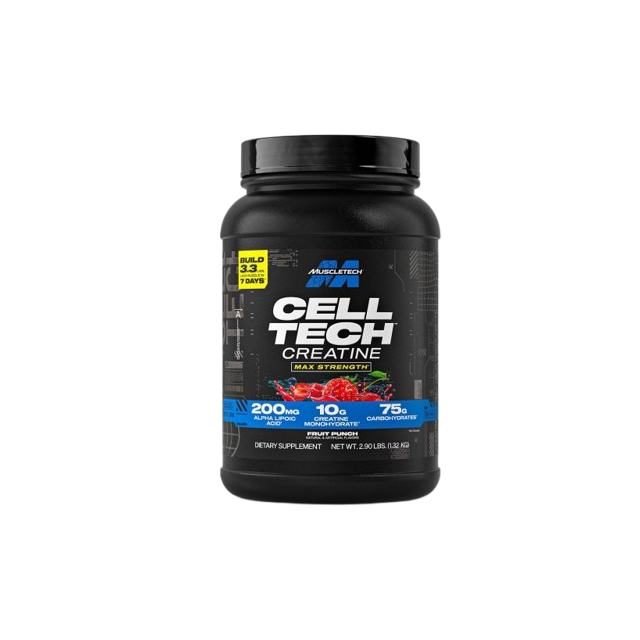
Muscletech Cell-Tech Creatine 2.9lb - Fruit Punch



MuscleTech Cell-Tech — Creatine + Carb Performance System
Creatine alone leaves uptake on the table. Cell-Tech pairs 5g of creatine monohydrate per scoop with a multi-stage carbohydrate matrix engineered around the insulin-driven mechanism that increased muscle creatine accumulation by 60% in the landmark Green et al. trial.1
Who Cell-Tech Is For
- Train hard 4–6 days a week and want creatine that loads quickly without the GI distress of straight dextrose
- Use creatine post-workout and want the carbohydrate dose dialled in rather than guessed at
- Have plateaued on plain creatine monohydrate and want to address the uptake side of the equation
- Care about the science behind a formula, not just the marketing
- Want a single ready-to-mix product instead of stacking dextrose, creatine, and electrolytes manually
Why Pair Creatine With Carbs
Insulin opens the gate. Creatine enters muscle cells through the SLC6A8 transporter, which is driven by the cell's sodium gradient. Insulin activates the Na⁺/K⁺-ATPase pump, steepens that gradient, and accelerates creatine transport into muscle (Steenge et al., 1998).2
Carbs unlock the +60%. In the landmark trial on this mechanism, men taking 5g creatine alongside carbohydrates four times daily for five days showed a 60% greater increase in muscle creatine than men taking creatine alone (Green et al., 1996, American Journal of Physiology).1
Cell volumization, not bloat. Creatine acts as an osmolyte, drawing water inside the muscle cell. Insulin-driven glycogen storage adds roughly 3g of water per gram of glycogen. This intracellular swelling has been shown to independently signal anabolic activity (Häussinger et al., 1993, The Lancet)3—and it is functionally distinct from the subcutaneous water that causes a "puffy" appearance.
The Multi-Stage Carb Design
A single sugar source forces a trade-off between insulin spike and gut tolerance. Cell-Tech sequences three carbohydrate sources to deliver both:
Dextrose
Pure glucose. Drives the immediate insulin spike that activates the creatine transporter—the mechanism Green and Steenge tested.
Highly Branched Cyclic Dextrin (HBCD)
Roughly 2,000× the molecular weight of glucose. Empties the stomach about 33% faster than glucose with a fraction of the osmolality—sustained delivery without the GI distress associated with high-dose dextrose (Takii et al., 2004, 2005).4
ModCarb® (Whole-Grain Blend)
Oat bran, quinoa, buckwheat, and millet. Slower-releasing complex carbohydrates for sustained glucose availability after the acute insulin window closes.
What's In Each Scoop
Per 1 scoop. Optional 5–7 day load runs at 2 scoops post-workout daily; maintenance is 1 scoop daily.
Creatine Monohydrate (5g)
The most-studied form of creatine in sports nutrition. The reformulated Cell-Tech moved to creatine monohydrate exclusively, replacing the previous monohydrate + creatine HCl blend.
Multi-Stage Carb Matrix (38g, 15g sugar)
Maltodextrin, dextrose, ModCarb®, modified food starch, and HBCD—engineered around the carb-to-creatine ratio that drove the Green et al. uptake result.
BCAAs (1g, 2:1:1)
Leucine, isoleucine, valine in the standard recovery-phase ratio.
Alpha-Lipoic Acid (100mg)
An antioxidant involved in glucose metabolism. Included as a supporting ingredient in the carb matrix.
Senactiv® (25mg)
Patented Panax notoginseng + Rosa canina extract. Manufacturer (NuLiv Science) research suggests it may support endurance and glycogen replenishment.
B-Vitamins (B6, B12)
Co-factors involved in normal energy metabolism.
What the Research Says About Cell-Tech
Cell-Tech itself has been studied in one published trial. Tarnopolsky et al. (2001, Medicine & Science in Sports & Exercise) tested Cell-Tech (10g creatine + 75g glucose) against a protein-dextrose comparator over 8 weeks of resistance training in untrained men. The Cell-Tech group increased bench press by ~17%, leg press by ~29%, and biceps curl by ~28%.5 The protein-dextrose group achieved comparable strength gains—a finding worth knowing rather than hiding. The mechanism behind those numbers is the same one that holds for any well-designed creatine-plus-insulin-driver protocol, which is exactly what Cell-Tech delivers in a single ready-to-mix scoop.
How to Take Cell-Tech
The protocol is built around the post-workout insulin window when the SLC6A8 transporter is most responsive.
Optional 5–7 day load
2 scoops in 350–500ml cold water immediately post-workout, daily. Loading saturates muscle creatine stores faster but is not required—a daily 5g maintenance dose gets you to the same place in 3–4 weeks.
Maintenance dose
1 scoop in 350ml cold water post-workout on training days. On rest days, take 1 scoop with breakfast or any meal containing carbohydrates.
Mix, don't blend
Shake 15–20 seconds in a shaker. The carbohydrate matrix settles fast—drink within 5 minutes of mixing.
Stack with whey if preferred
50g protein paired with carbohydrate produces the same insulin response as ~96g carbohydrate alone (Steenge et al., 2000).6 A Cell-Tech + whey isolate post-workout shake is a valid alternative to running both products separately.
Choose Your Size
Both sizes contain the identical formula. Pick on supply duration and per-serve cost.
2.9lb — Fruit Punch
Best for testing how your body responds, or for shorter cycles. Roughly 3–4 weeks at 1 scoop per day, or about 2 weeks if you load.
FAQ
Do I really need a loading phase?
No. Loading saturates muscle creatine stores in 5–7 days; skipping it gets you to the same place in roughly 3–4 weeks of daily 5g doses. Choose loading if you want results faster; skip it if you want lower carbohydrate intake during week one.
Can I just buy plain creatine monohydrate and mix it with juice?
Yes, and it works. Cell-Tech engineers the carb-to-creatine ratio, sequences three carbohydrate sources for tolerance, and standardises dosing per scoop. Choose Cell-Tech if you value precision and convenience; choose DIY if you want lower per-serve cost and don't mind measuring.
Is the carbohydrate content too much if I'm cutting?
38g of post-workout carbs is rarely the problem on a cut—they are going straight into glycogen replenishment. If you're tracking calories tightly, count the ~150kcal in your daily intake or step down to a single scoop and pair with a smaller protein dose.
Is 5g per scoop the right creatine dose?
Yes—5g is the standard maintenance dose used in the majority of creatine research over the past three decades. Loading protocols use 20g/day (4×5g) for 5–7 days; daily maintenance is 3–5g. Cell-Tech matches this with 5g per scoop.
Why both sucralose and stevia?
Two sweeteners blended together flatten the aftertaste of either alone. Stevia rounds the sweetness profile; sucralose carries the flavour intensity needed at this carbohydrate load. Applies to the international formula.
How do I check if it meets my sport's testing requirements?
Always batch-verify. No supplement product carries a permanent guarantee across every production run. If you compete in a tested sport, check the batch number on the tub against your federation's banned substance database (Drug Free Sport NZ, Informed Sport, or NSF Certified for Sport) before use, and photograph the tub for your own records.
Will I gain water weight?
You'll gain intracellular water, which is the point. Creatine pulls water inside the muscle cell where it triggers anabolic signalling—functionally different from subcutaneous water retention. Most users see a 1–2kg increase in scale weight during the first week.
References
- Green AL, Hultman E, Macdonald IA, Sewell DA, Greenhaff PL. Carbohydrate ingestion augments skeletal muscle creatine accumulation during creatine supplementation in humans. Am J Physiol. 1996;271(5 Pt 1):E821–E826.
- Steenge GR, Lambourne J, Casey A, Macdonald IA, Greenhaff PL. Stimulatory effect of insulin on creatine accumulation in human skeletal muscle. Am J Physiol. 1998;275(6):E974–E979.
- Häussinger D, Roth E, Lang F, Gerok W. Cellular hydration state: an important determinant of protein catabolism in health and disease. Lancet. 1993;341(8856):1330–1332.
- Takii H, et al. Effects of highly branched cyclic dextrin on gastric emptying and exercise performance. J Nutr Sci Vitaminol & Biosci Biotechnol Biochem. 2004–2005.
- Tarnopolsky MA, Parise G, Yardley NJ, Ballantyne CS, Olatinji S, Phillips SM. Creatine-dextrose and protein-dextrose induce similar strength gains during training. Med Sci Sports Exerc. 2001;33(12):2044–2052.
- Steenge GR, Simpson EJ, Greenhaff PL. Protein- and carbohydrate-induced augmentation of whole body creatine retention in humans. J Appl Physiol. 2000;89(3):1165–1171.
SUPPLEMENT FACTS
Serving Size: 1 Scoop (49g)
Servings Per Container: Approx. 27
extract and Rosa canina fruit extract) 25mg †
Ingredients:
Multi-Stage Carb Blend (Maltodextrin, Dextrose, ModCarb® [Oat Bran, Quinoa, Buckwheat, Millet], Modified Food Starch, Highly Branched Cyclic Dextrin), Silicon Dioxide, Citric Acid, Natural and Artificial Flavors, Beet Juice Powder (Color), Sucralose, Beta-Carotene (Color), Rebaudioside A (from Stevia Leaf Extract).
*Percent Daily Values (DV) are based on a 2,000 calorie diet.
†Daily Value (DV) not established.